
 Русский
 Deutsch
 Français
 Español
 Italiano
Free
€0
- All 10 lessons and 29 quiz questions
- Getting to know the controls
- Turn on the spot
- Back out of the slot
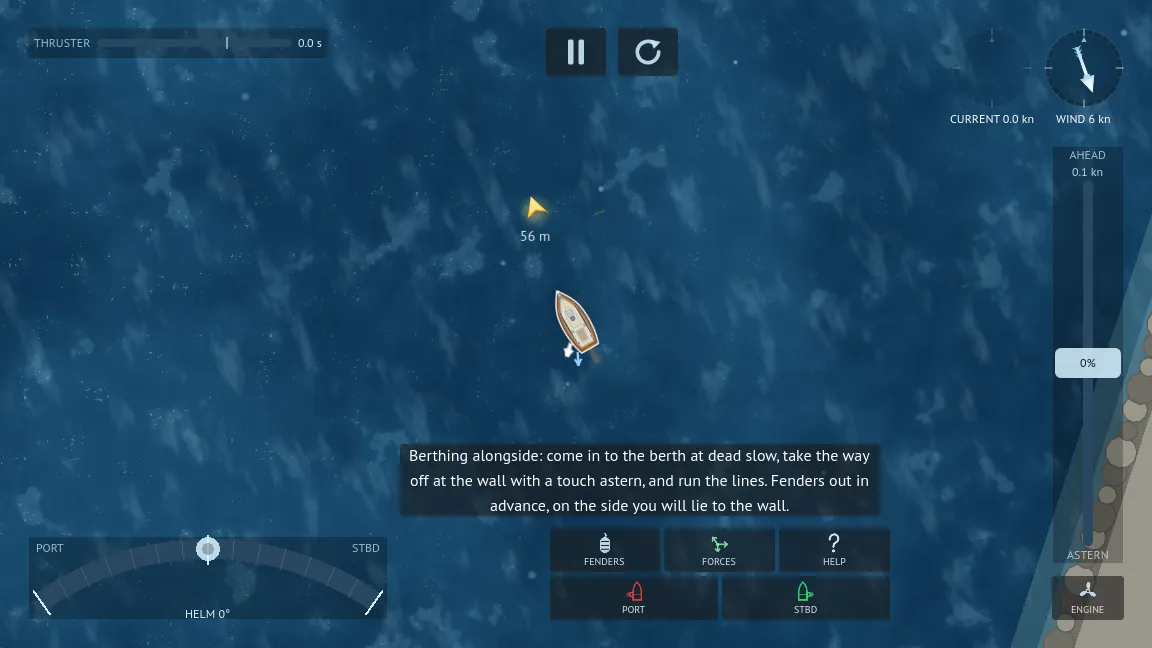
- Berthing alongside
Sailboat Docking Simulator
A tight slip, a crosswind, boats on both sides and people on the pontoon. Rehearse every approach here until your hands know it: prop walk, windage, current, lines and fenders behave the way they do on a real yacht.
iPhone, iPad and Android phones and tablets
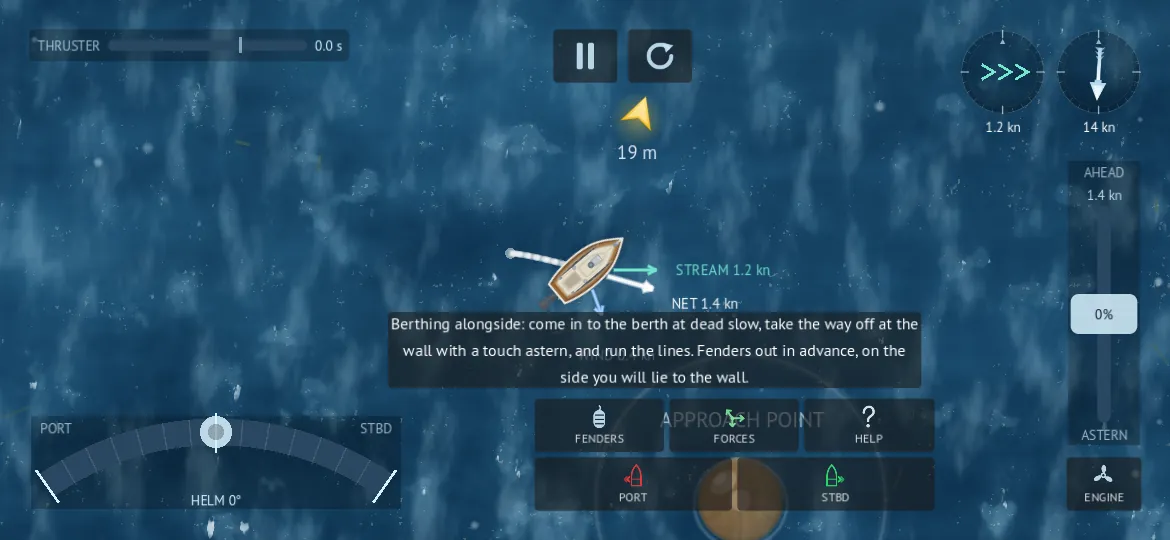
Why practise docking
Out at sea mistakes are forgiven. In the marina they are measured in gelcoat. The trouble is that you only get to practise when it is already for real — with the charter deposit on the line and the neighbours watching.
Sailboat Docking Simulator gives you the rehearsal that real life does not: the same approach, the same wind, as many times as you need. Back out, try again, see exactly which force pushed the bow off — until the manoeuvre becomes second nature.
The coach speaks before the mistake, not after.
What you can practise
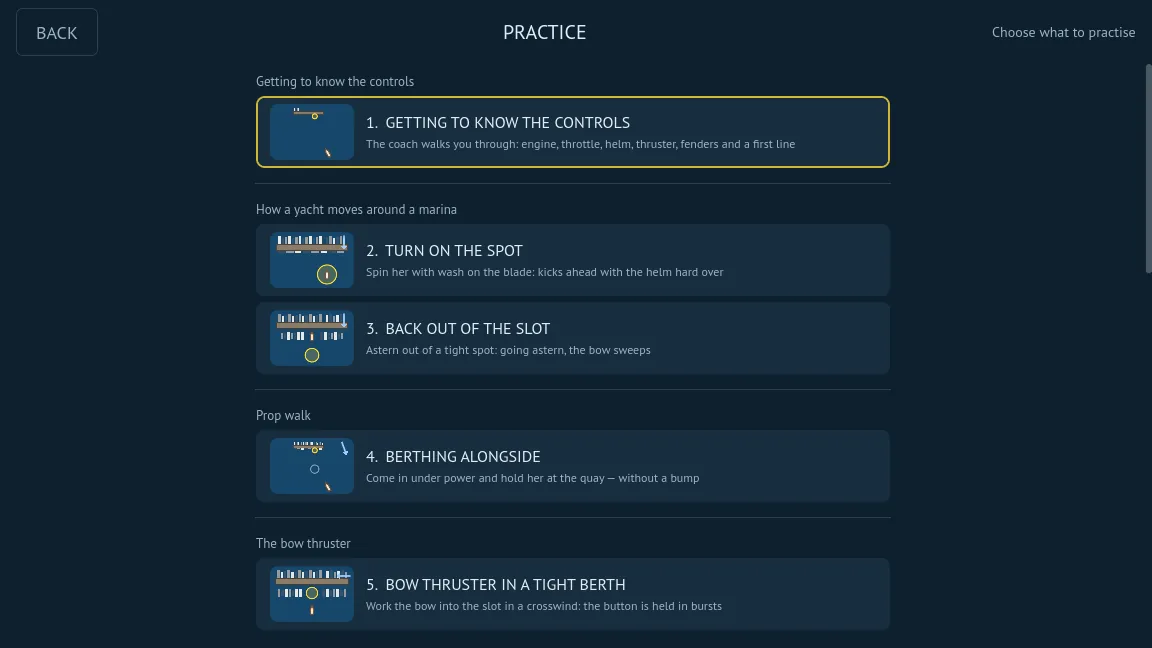
Every drill takes place in a real-looking marina with pontoons, quays and moored neighbours. Weather variants replay the same approach in a different wind.
01Free
The coach walks you through engine, throttle, helm, thruster, fenders and your first line.
02Free
Spin her in her own length with prop wash on the rudder: short kicks ahead, helm hard over.
03Free
Astern out of a tight spot — and feel how the bow sweeps when you go astern.
04Free
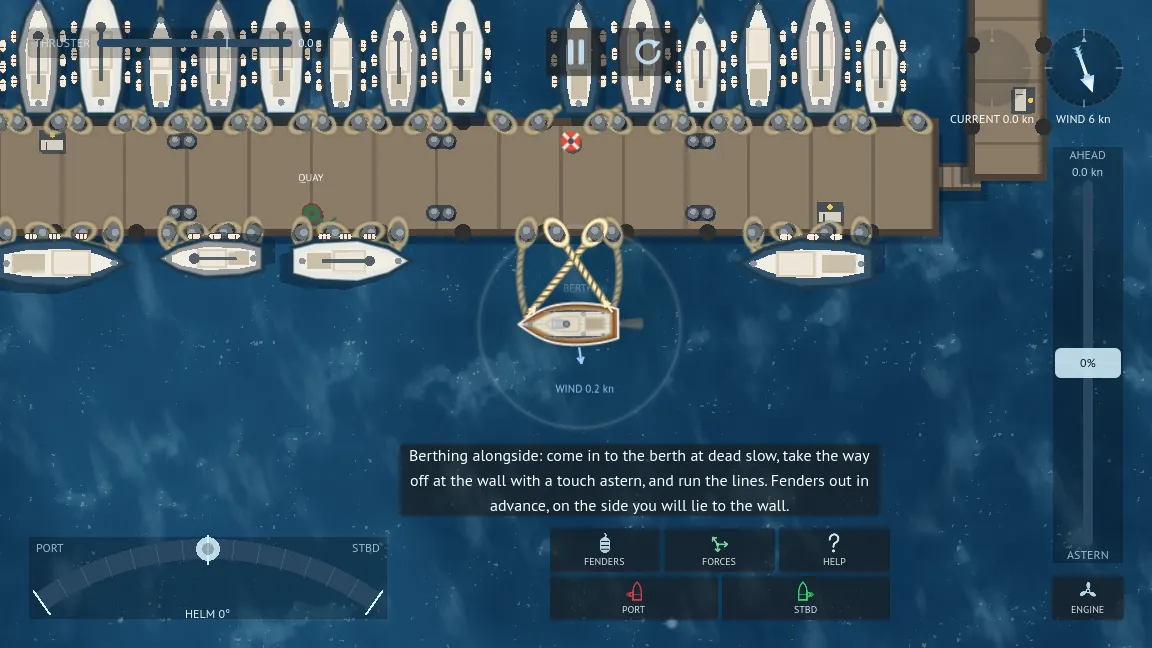
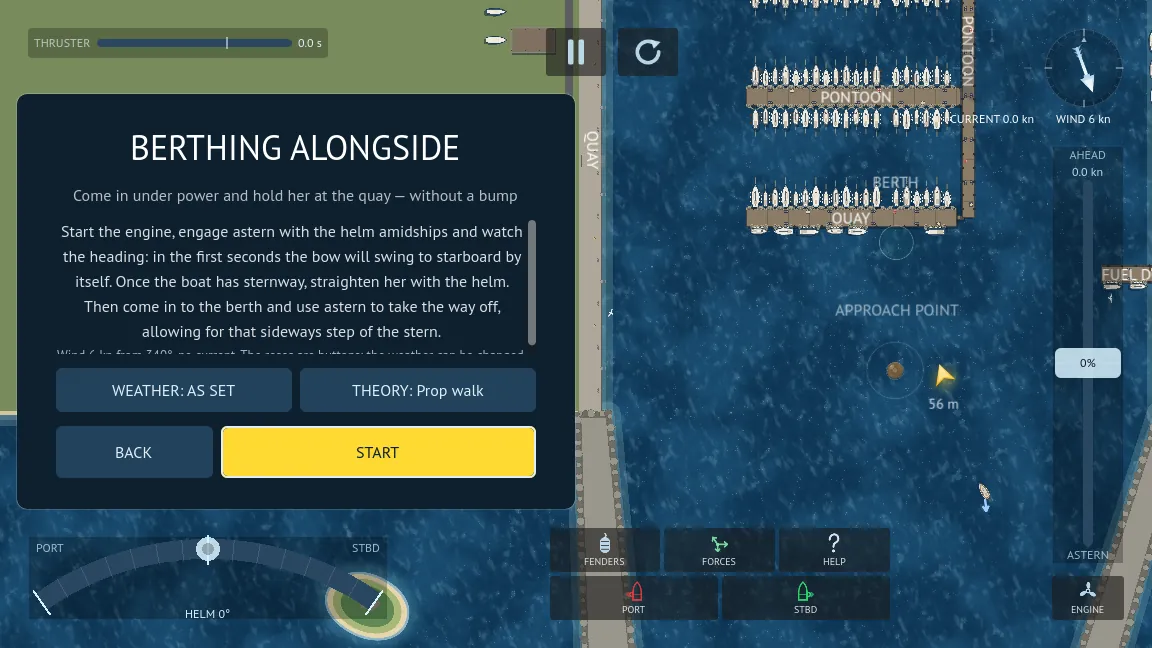
Come in under power and hold her at the quay without a bump.
05
Work the bow into the slot in a crosswind, using the thruster in short bursts.
06
Run between the pontoons and hover at the berth, holding off wind and current.
07
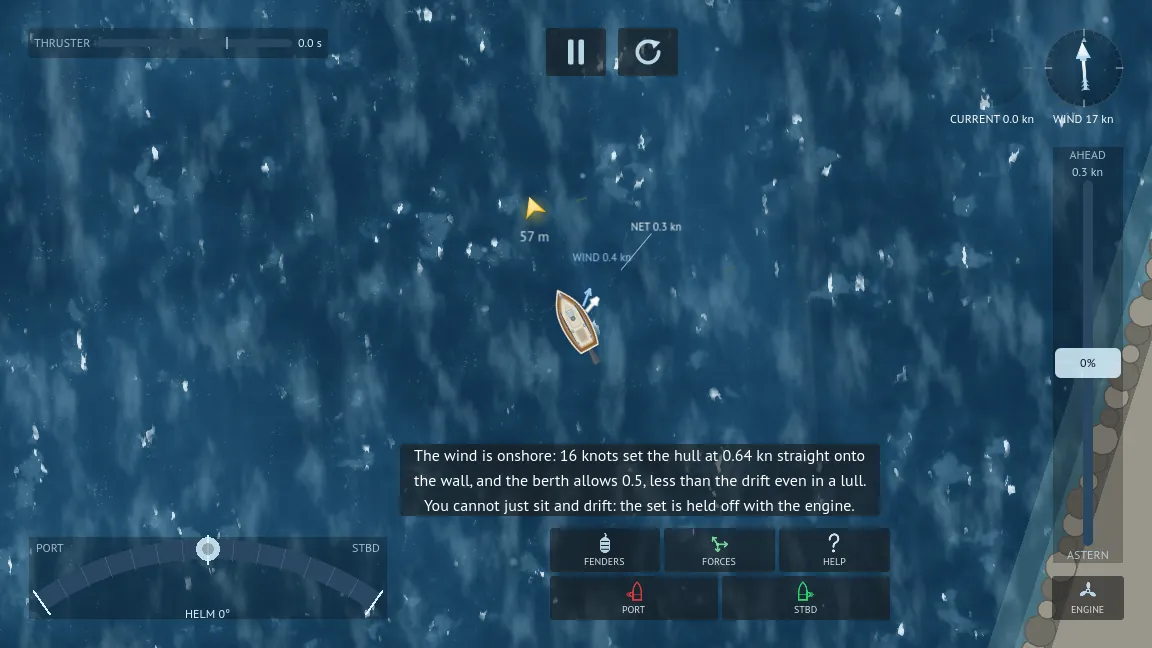
The wind pins you onto the wall: come in and hold off without landing hard.
08
The wind blows you off the dock: keep the bow up and don't let her fall off.
09
The approach is already botched: back out astern and make a clean second attempt.
10
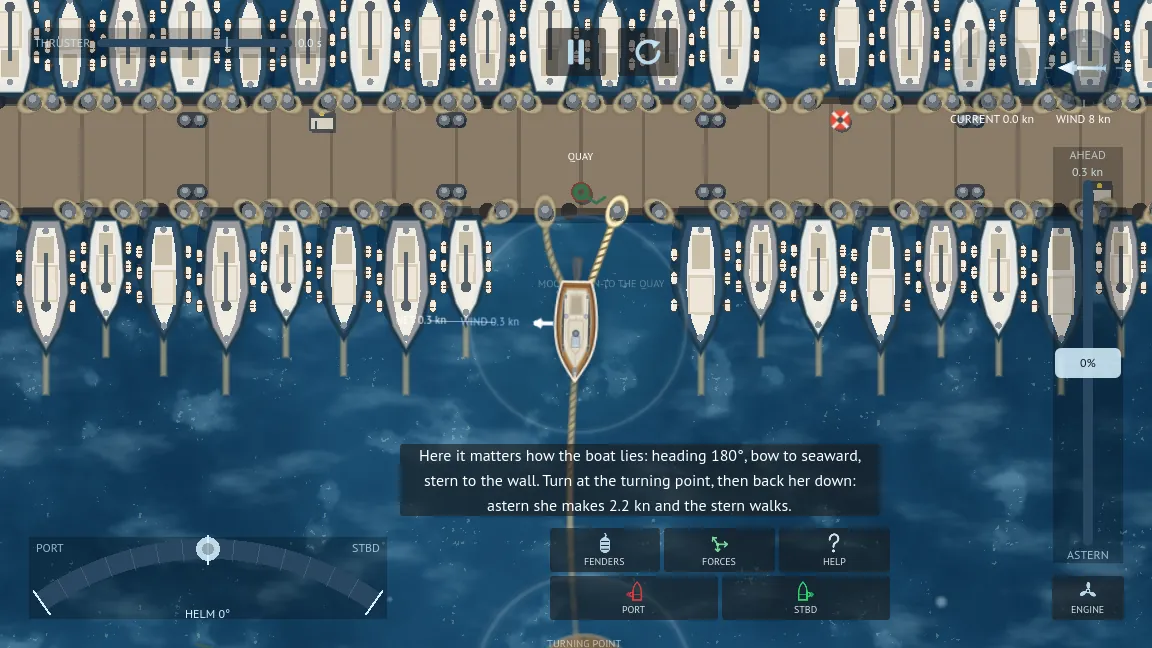
Med mooring: turn bow to seaward, back the stern to the quay and pick up the lazy line.
11
The gap is narrower than the boat with fenders: ease the neighbours apart with the stern.
12
The engine holds the stern while the lines go ashore — the short-handed trick.
13Lab
The boat is already moored: what each weather does to her and which line holds.
14Lab
One line, then more: how wind and stream swing the boat and what every extra line adds.
Real boat handling
No arcade steering. Diesel ahead to 5.5 knots, astern to 3 — and everything that makes close-quarters handling hard.
Astern, the stern kicks to one side. Learn which way — and turn it into your best friend when docking.
A burst of throttle over a hard-over rudder turns the boat before she gathers way. Twin rudders? Switch in settings and feel the difference.
At low speed the wind takes the bow first. Crosswind docking is about keeping it up.
The stream carries the whole boat sideways. Aim upstream of the berth, not at it.
Short bursts, a heat gauge and a breaker that trips — just like the real one, including when it gives up in a strong crosswind.
Land on fenders and it is docking. Land bare-hulled and you get a flash and a scuff on the topsides.
Tap a cleat, tap the bollard: lines alongside or stern-to with a lazy line, a winch to take in slack, and forces that genuinely hold the hull.
How it works
Ten short lessons explain prop walk, windage, lines and the approach plan, each with a quick quiz.
Jump straight from the lesson to its drill. Rudder arc on the left, throttle lever on the right — two thumbs, like a real helm.
Force arrows on the water and your track astern show what is really moving the boat. The coach warns you before you hit something.
Screenshots
Who it is for
Arrive at the base knowing how the boat will react when you put her astern in a crosswind.
Get the theory into your hands before on-the-water training or a practical exam such as RYA Day Skipper or ASA.
Sharpen close-quarters skills before the season or before switching to a boat with twin rudders.
Pricing
€0
Subscriptions renew automatically and can be cancelled any time in your store settings. Prices are shown in your local currency in the store and may differ from the ones above.
FAQ
Yes, you can start for free: all ten lessons with quizzes and four practice sessions — the controls tutorial, turning on the spot, backing out of a slot and berthing alongside — stay free forever. Full access unlocks the other ten sessions and weather variants, as a monthly or yearly subscription or a one-time lifetime purchase.
It is a sailing yacht under engine with a simplified but honest model: 5.5 knots ahead and 3 astern, prop walk, prop wash on the rudder, turning inertia, windage that takes the bow, current set, a bow thruster that overheats, fenders and mooring lines that hold the hull with real forces. It is not an arcade game — the boat carries her way and does not stop when you let go.
Yes. Two sessions are dedicated to it: backing stern-to onto a quay and picking up the lazy line, and squeezing stern-first into a gap narrower than the boat with fenders. A lesson explains the approach before you try.
That is one of its main goals. A dedicated lesson explains prop walk, and you feel it in every manoeuvre astern — backing out of a slot, stern-to mooring, aborting an approach. Force arrows show exactly when the stern starts to kick.
No. It is a training aid that helps you understand what the boat will do and rehearse the sequence, so your time on the water is spent refining, not guessing. It is not a navigation tool.
Everything works offline. There is no account, no ads, no analytics and no tracking in the app — it collects no personal data at all. The only network request is the store's own purchase dialog.
iPhone and iPad, and Android phones and tablets. The simulator plays in landscape with two-thumb controls: rudder on the left, throttle on the right.
English, Russian, German, French, Spanish and Italian, with proper nautical terms in each. The language follows your phone and can be changed in settings.
Download Sailboat Docking Simulator and rehearse the approach tonight. The first lessons and drills are free.